Category Archives: Flute Making

Martin Doyle Attends Art In Action

Art in ActionArt in Action is a three-day arts and crafts festival held every June Bank Holiday Weekend. Top artists and craftspeople from many different disciplines are invited to set up studios, stalls and workshops to demonstrate their work and skills live. Over a hundred craft, fine, liberal and performing artists demonstrate and sell their art to the public. An extensive range of children and adult art classes are also available, all set in the lovely house and grounds of Townley Hall near Drogheda in County Louth, Ireland. Art in Action is affiliated to the John Scottus School.

Art in Action is organised and staffed by the School of Philosophy, an educational charity in Dublin (CHY 5791). Everyone who contributes to the organisation and staffing of the event does so entirely on a voluntary basis and without payment of any kind. This is at the core of the ethos of Art in Action and contributes to its unique atmosphere – about which both visitors and artists frequently comment.

A music session in full swing at Martin Doyle's stand during Art in Action 2010.

A music session in full swing at Martin Doyle’s stand during Art in Action 2010.

Continue reading

Baroque Flutes by Martin Doyle

A new page presenting information regarding the wooden Baroque flutes made by Martin Doyle has recently been added to his website.

Martin Doyle completed his first set of Baroque flutes early in 2000. Originally working with African Blackwood, he modelled his Baroque flute design on an eighteenth century Rottenburgh Baroque flute. Martin has also made Baroque flutes from Boxwood, three of which feature below.

Three Martin Doyle Baroque flutes made from Boxwood.

Three Martin Doyle Baroque flutes made from Boxwood.

More details can be viewed here: Baroque Flutes »

The Music Tree Airs On Newstalk

The Different Voices series on Ireland’s Newstalk 106-108 FM radio station continues with The Music Tree – a documentary featuring the Irish flute maker Martin Doyle.

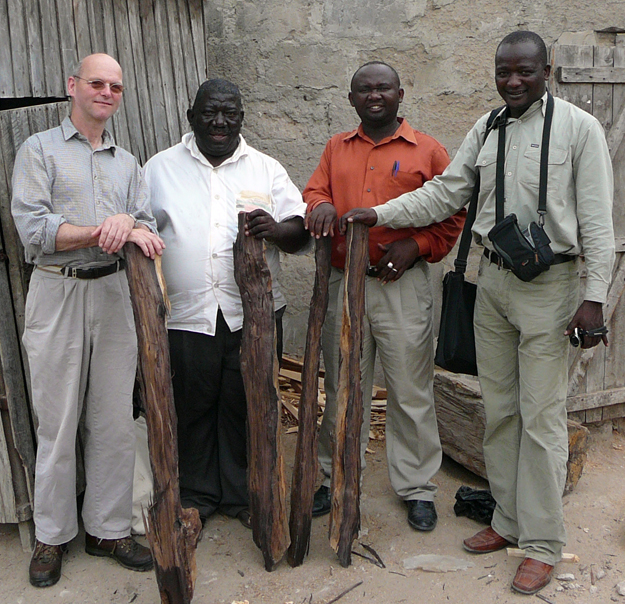
Martin Doyle in Tanzania.

Martin Doyle in Tanzania.

As a young man, Martin Doyle travelled from his native Bray in County Wicklow to Africa. He was employed as a ships engineer for a couple of years – a job he took to raise much needed funds to purchase expensive tools and machinery for his dream of developing a flute making business in the early 1980s. The hard work and time away from Ireland paid off, and as the years have passed, the dream has blossomed into a reality.

Now an established and highly respected flute maker living in County Clare, Martin decided to revisit East Africa where African Blackwood (Mpingo as it is known in Tanzania), the timber that Martin makes most of his flutes from, is grown. There he hopes to visit the forests where the Mpingo grows, to meet those whose livelihoods depend upon it. He also hopes to make an Irish flute with the help of local craftsmen in a Tanzanian workshop – quite possibly a world first!

Martin Doyle at the workshop in Dar es Salaam, Tanzania.

Martin Doyle at the workshop in Dar es Salaam, Tanzania. From left: Martin, Focus Senga, Salim and James Laizer.

Continue reading

The Tanzanian Adventure Unfolds

Martin Doyle in Tanzania.

Martin Doyle in Tanzania.

Martin Doyle is currently visiting Tanzania with Nina Perry of Falling Tree Productions to make a radio documentary called The Music Tree for the Irish radio station Newstalk. The Music Tree will feature Martin Doyle as an instrument maker visiting the area of East Africa where the Mpingo (African Blackwood) trees grow. Since the nineteenth century African Blackwood has been a timber favoured for woodwind instruments as its density, tonal properties, stability and durability are incomparable.

This trip is in its own way an historical occasion as many of the local people of Tanzania, some of whom are involved in burgeoning Mpingo conservation projects, have never before met a European craftsman who uses their timber to make musical instruments. Martin accomplished the task of making a flute with some of the local Mpingo carvers on the third day of his visit and by all accounts they were enthralled when it was played to them.

Nina Perry is kindly authoring a blog dedicated to the trip – Music Tree – so that we distant onlookers can keep abreast of events. No story, small or large, is complete without a picture or two, so here is one from Nina’s blog:

Street scene in Dar es Salaam, Tanzania.

Street scene in Dar es Salaam, Tanzania.

Tanzania Update

In a recently post, Martin Doyle, Tanzania And The Music Tree, we highlighted Martin Doyle’s upcoming trip to Tanzania in August with British composer and sound designer Nina Perry. Two excerpts from that post:

Martin Doyle is to feature in a radio programme to be called The Music TreeNewstalk. The project is being headed by Nina Perry (who also produced Sounding Post which looked at the use of wood for instruments and featured several instrument makers including Martin Doyle) for Falling Tree Productions. […] The Music Tree is to accompany Irish flute-maker Martin Doyle from County Clare to Tanzania where he plans to demonstrate Irish flute making so that accomplished local craftsmen might learn his skills to boost the economy surrounding this rare wood and, for the first time, hear the sound of instruments made from the local blackwood trees.

Nina Perry has very kindly offered this update on the trip:

Continue reading

Martin Doyle, Tanzania And The Music Tree

Flutes for Africa

Mpingo logger, Tanzania.

Mpingo logger, Tanzania.

Martin Doyle is bound for the East African nation of Tanzania this coming August to take part in the production of a radio programme.

Tanzania is home to the famed Mpingo tree from which the highly valued timber known as African Blackwood is harvested. This wood has been one of the first choices for woodwind instruments such as clarinets, oboes, bag pipes and flutes for over 150 years now, but was also valued by furniture making as far back as the time of the Egyptians. It is a timber favoured for it’s density, durability and exceptional tonal qualities.

Martin Doyle is to feature in a radio programme to be called The Music Tree that is being produced for the Irish radio station Newstalk. The project is being headed by Nina Perry (who also produced Sounding Post which looks at the use of wood for instruments and featured several instrument makers including Martin Doyle) for Falling Tree Productions. This from Nina Perry:

Nina Perry

Nina Perry – music, sound and radio.

“The Music Tree is to accompany Irish flute-maker Martin Doyle from County Clare to eastern Tanzania where he plans to demonstrate Irish flute making so that accomplished local craftsmen might learn his skills to boost the economy surrounding this rare wood and, for the first time, hear the sound of instruments made from the local blackwood trees.”

Continue reading

Just Added: A Flute Maker/Player Dyad

Martin Doyle, Desi Wilkinson and Elizabeth Petcu

Martin Doyle (flute maker), Desi Wilkinson (flute player) and Elizabeth Petcu (essayist).

In 2002, as the final semester essay undertaken to gain her Masters Degree in Music, Martin Doyle’s good friend Elizabeth Petcu wrote ‘A Phenomenological Study into the Experiences of a Flute Maker/Player Dyad’. With her kind permission, this essay has been reproduced on Martin Doyle Flutes.

This phenomenological study is an interesting and illumining insight into the relationship between a flute maker, Martin Doyle, and a flute player – in this case the renowned Irish traditional musician and music scholar, Desi Wilkinson.

The following are excerpts from Elizabeth’s essay.

From the introduction:

Discovering a flute maker’s workshop in my local town a few years ago enabled me to combine my lifelong fascination for woodwork and wood turning with my love of flutes and flute playing. Under the allure of the atmosphere in the workshop and listening to the philosophising of the maker, caused me to be curious about the “ingredients” contained in the instruments. I wondered if the experiences of the maker, as he worked, could be converted into a more tangible form. The phenomenological approach, also recently discovered, suggested itself as being a possible way to reveal the powerful, unspoken psychological processes and energies which I could palpably feel in the workshop.

Continue reading