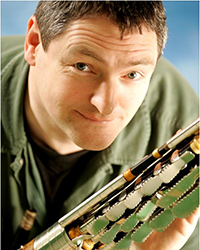
Our good friend Anurakta O’Neill recently found a forgotten video clip from Martin Doyle’s trip to New Zealand in December of 2014. Martin was visiting Anurakta at his workshop in Christchurch and he asked Martin if he knew the famous O’Neill’s March. Martin proceeded to play that tune and was then prompted to talk about another tune that he had played earlier in the day called Return from Fingal. This second tune relates to the Battle of Clontarf in 1014 AD and the subsequent death of the famed Irish High King Brian Boru. As usual, Martin brought the magic and it was a lovely wee interlude for those present. Martin is playing one of his own traditional style keyless D flutes that is made from cocus wood.
Several days ago, our webmaster discovered three video clips in an archive from Martin Doyle’s trip to New Zealand in December of 2014. But first, a couple of anecdotes…
Poor Martin! He stayed in Christchurch for three weeks, and for the first week he was stuck in bed with a nasty bug that had latched on to him during the long flights from Ireland to New Zealand. Exhausted from his pre-Christmas rush to get his flute orders out to customers before his holiday, Martin had become vulnerable to airplane bugs. As if that wasn’t enough, during the period of his illness, an earthquake gave the area a good shake in the wee hours of one morning and the old bed that Martin was sleeping on partially collapsed. It was a real welcome to “The Shaky Isles“, as New Zealand is sometimes called. Remarkably Martin seemed to almost enjoy his first time experience of that aspect of nature’s power!
Having recovered from the dreaded lurgy and the quake, Martin did get a chance to have a look around Christchurch and the Canterbury region. During that time he was a guest at The Lotus-Heart vegetarian restaurant where he offered a couple of informal music sessions with some local musicians and small but appreciative audiences. Here are three video clips from those sessions that we posted on Martin’s YouTube channel recently. The local musicians are Shardul (Irish flute), John Wood (guitar and vocals), Jade Bell (bodhrán and vocals), Rowan Oliver (Irish harp) and her father Peter Oliver (guitar).
Question: Is there any kind of flute or whistle that is simpler than a simple system flute?
Answer: Well, as it turns out, yes there is. Known as the N’dehou, it is an end blown single note Pygmy flute that is made of bamboo.
Question: What can be done with one note?
Answer: One could mimic birds I suppose, but it turns out that, in the hands of the right person, much can be accomplished with a single note flute. A great exponent of the N’dehou is the Cameroonian composer, writer, and musicologist Francis Bebey (1929-2001). In the video below he demonstrates what a creative musician with a N’dehou might be capable of. In his words, it is a form of conversation that takes place between the flute and the player.
On a sunny Saturday morning in March (southern hemisphere Autumn) 2025, Ronan Browne visited and enchanted a gathering of around fifty souls with a message of peace in the Irish language – and a lovely traditional Irish air. Despite the fact that he did not visit physically, but in digital form, Ronan touched the heart’s of all who had gathered at Zuvuyaland, a peaceful nature reserve that is a short distance from the great lake Taupō in the central North Island of New Zealand.
The purpose of this gathering revolved around the Peace Poles at Zuvuyaland. A Peace Pole is a monument that displays the message “May Peace Prevail on Earth” in the language of the country where it has been placed, and usually some additional translations. The message is often called a peace prayer. On this particular day eight new translations in Irish, Bengali, Danish, French, Czech, Greek, Russian and Ukranian were added to the poles. At the gathering were members of the Zuvuyaland society, the local community and twenty members of the Sri Chinmoy Oneness-Home Peace Run who were visiting Taupō for the weekend.
Ronan had been invited to offer a translation in Irish of “May Peace Prevail on Earth” by the organisers and he kindly recorded a message and a tune for the ceremony. When it was played, it was as though Ronan was standing there among us – it was quite special. And how lovely it was to hear him playing the traditional Irish air Bonny Portmore on his Martin Doyle flute.
So we are very grateful to Ronan for his efforts and to his friends who helped with the translation. It is sometimes difficult to exactly translate an English phrase into some languages. The Irish words for May Peace Prevail on Earth, Síocháin do Chách, Anois is go Brách, translates back to English as “Peace to All, Now and Forever” – an equally fitting phrase to the original.
We invite you to enjoy this precious moment that was captured on video.
Since 1986, many significant landmarks around the globe – from natural wonders to entire nations – have been dedicated to peace as part of the Sri Chinmoy Peace-Blossoms programme. The Peace-Blossoms family offers an opportunity for different communities to share in mankind’s common quest for peace.
“What does peace do? Peace blossoms. What else? Peace spreads. What else? Peace illumines. What else? Peace fulfils.” – Sri Chinmoy.
Occasionally Martin Doyle’s webmaster browses the Chiff and Fipple forum boards to read what the folks out there have been chatting about, especially with regards to Martin Doyle flutes. One can learn a lot and also see the progress that we have made over the years as a community. Recently he came across an interesting post from March in 2010 by Jim Stone – a flute player from St. Louis, USA.
The context was that someone had spotted a Martin Doyle flute on Ebay and was casting around at the time to see what people knew about Martin’s flutes. Jim was first to comment with these kind words…
I’ve played a couple of Doyle flutes. These are really good flutes.
“To tuning slide or not to tuning slide – that is the question.”
The conversation then turned to the fact that the particular flute in question did not have a tuning slide. Martin Doyle’s basic flutes, whether celtic or traditional models, do not come with tuning slides but they can be ordered with tuning slides or even retro fitted after purchasing. Jim Stone had the following to say about the ‘no tuning slide’ issue.
No slide. The flute is tunable via the tenon and is, in fact, widely played in sessions. The craftsmanship is very good, the design is very good. The headjoint is all wood, and the flute has a great woody sound, good volume. It’s a bit on the Pratten side of things but easy enough to handle and finger. I would gladly buy one of these if I didn’t have quite enough D flutes already.
A Doyle flute is in evidence on the first part of this video.
Jim was on the money with his comments regarding tuning slides. Many flute players do not use them and they get along just fine. A prime example is in the YouTube video that Jim posted a link to. The flute player in the video is Ronan Browne, who is playing a Martin Doyle flute in the first instrumental break and a set of Uilleann pipes in the second. It is a lovely example of the reedy sound of an Irish flute without a tuning slide – ie: no metal lining the head joint. Here are some words from a testimonial that Ronan sent for Martin Doyle’s website some years back…
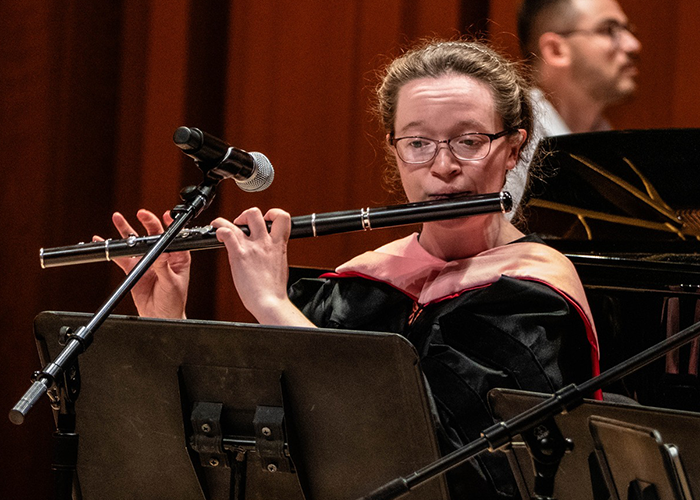
This past August Martin Doyle received a lovely testimonial from American flutist Shana Stone, a performer, teacher and composer-arranger, who had purchased one of Martin’s six key flutes made from African Blackwood. These are her words …
“Martin Doyle’s flutes are nothing short of extraordinary. My six-key flute, made from African blackwood, speaks easily and with plenty of punch, sass, and personality. It sweetly sings the old airs and has plenty of bubble and spark in the faster tunes, and the low D barks wonderfully. This flute has such depth, soul, and clarity that it makes me fall in love with it all over again every time I play it. I could spend a lifetime getting to know its distinct voice. It is easily accessible to play, yet filled with an expansive palette of nuance to explore. The prices are extremely reasonable, and Martin is communicative, caring, and the best person to work with!”
About Shana Stone
“Shana is a thoughtful, engaging musical artist and classically trained flutist devoted to interpreting and sharing music with listeners. She graduated in May 2025 with her Doctor of Musical Arts degree from the University of Georgia, where she served as a Graduate Teaching Assistant for the UGA Flute Studio and performed with the Southern Wind Quintet. She now intends to focus on growing her teaching studio and pursuing an orchestral career. She earned her Master’s degree in Flute Performance from the University of North Carolina at Greensboro (where she studied with Dr. Erika Boysen and Dr. Tim Hagen) and her Bachelor’s degree in Flute Performance from the University of Georgia (where she studied with Professor Angela Jones-Reus). Other teachers include Daniel Self, Kristen Holritz, Elizabeth Klein Teplitsky, and Emily Zirlin.” Read more: My Story | Shana Stone »
We just came across a video clip of our dear friend Ronan Browne playing his Martin Doyle flute. The tune, which Ronan describes as “beautiful, sad, haunting song [that] was sung by my grandmother Delia Murphy“, is Cold Blows the Wind O’er My True Love and the video was recorded in the covered dry dock in Shannon Harbour by Justin Conneely.